Digitally checking in travelers, communicating with your staff, processing payments and coordinating between departments all have one thing in common: hotel management software. And when you’re choosing what to use, the stakes are high. The wrong platform can frustrate both your staff and guests, limiting your revenue opportunities.
But using the right software makes hotel management a breeze. It lets your team move in unison, provides guests with a smooth experience and maximizes revenue opportunities across the board. In this guide, we’ll explain how to choose the best hotel management software for your property that’ll support your growth goals, improve the guest journey and scale with your business.
Key highlights:
Hotel management software is a platform built from multiple technology layers that centralize hotel operations, including guest communication, payments and operational workflows.
The best systems improve staff productivity, streamline guest interactions and create new revenue opportunities across the guest journey.
When evaluating platforms, hotels should prioritize integration capabilities, automation, scalability and guest-facing features.
Canary Technologies’ Guest Engagement Platform modernizes hotel operations from booking to checkout while identifying opportunities for revenue and efficiency.
What Is Hotel Management Software?
Hotel management software is a digital platform built from multiple technology layers that a hotel chooses to help run daily operations. It brings together key components like guest profiles, payments, housekeeping updates and reporting so teams can manage operational tasks in a way that ensures the information is shared across relevant tools.
Day to day, it means when a guest checks in, information like their name and room number is available to other connected functions: housekeeping knows the room is occupied, the restaurant can charge to the room and managers see the guest on reports. Hotel management software keeps all of this information organized so guest service stays consistent.
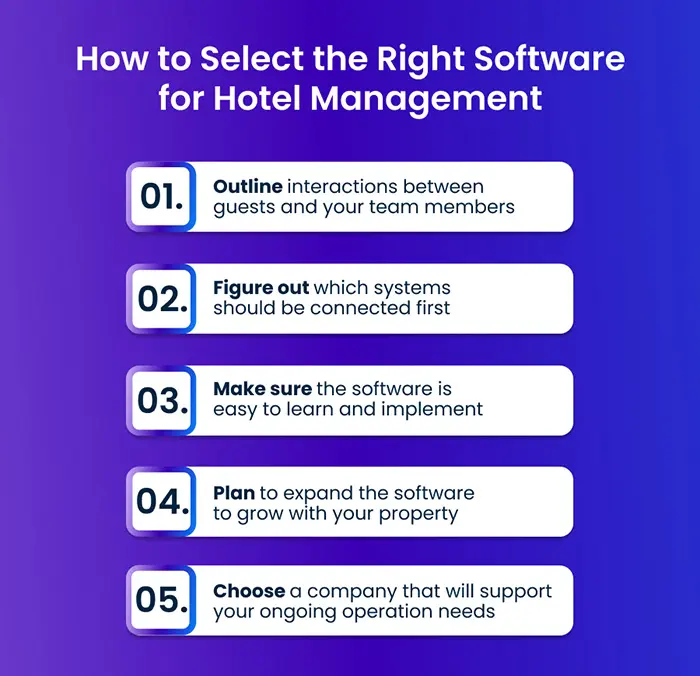
How to Select the Right Software for Hotel Management
Before you can choose the right hotel management system, you must understand your property’s operational needs. This is not the time to get distracted by comparing vendors or features. First, step back and evaluate how technology fits into your day-to-day workflows. Look for what causes bottlenecks for your team, where guests experience friction and which processes require better data-flow, visibility or automation.
Here is a practical framework for evaluating hotel management software and determining which features are most important for your property.
Step 1: Map Guest and Staff Touchpoints Across the Hotel Journey
Begin by identifying all points of interaction between guests and staff throughout the stay. This includes communication around bookings, check-in, in-stay conversations, payments, F&B service, requests and checkout. Every point of contact can either cause operational friction or deliver seamless service.
Mapping these moments reveals where technology can support your hotel operations. For example, long front desk lines, delayed housekeeping updates or a high volume of in-house calls often signal processes that could benefit from a management system upgrade.
Step 2: Identify Which Systems Must Be Connected First
Integrated hotel data is your property’s "auto-suggest." Without it, your staff is stuck in manual-entry purgatory; with it, information flows instantly and accurately where it’s needed.
Modern hotels juggle a complex tech stack — Property Management Systems (PMS), Revenue Management Systems (RMS), Booking Engines and Channel Managers, Group Booking Tools, Point-of-Sale (POS) Terminals, Payment Platforms, Housekeeping & Maintenance Software, TV & Media Suites and Guest Messaging & Engagement Tools — so it’s critical that these systems talk to each other. Solid integrations eliminate duplicate data entry, end the risk of human error and keep every department operating from a single source of truth.
Prioritize integrations that directly remove friction from the guest experience and the heaviest lifting (such as clicking between screens, exporting and importing reports) from your staff. Once you know what systems must be compatible, you can proactively bring this up in vendor discussions.
Step 3: Validate Day-One Usability for Frontline Teams
Even the most sophisticated software is a liability if your staff can’t or won’t implement it. When a platform is designed for the person actually using it, adoption is easy. Your team stops fighting the software and is empowered to focus on the guest. The numbers back this up: an HBR survey found that 89% of executives say driving adoption of employee-facing software is a high priority.
To ensure your tech stack actually gets used, look for:
Intuitive interfaces: Can a new hire navigate the basics without a manual?
Minimal training requirements: Does the workflow match the on-the-go reality of a busy lobby or back-of-house?
Built-in efficiency: Do the tools reduce clicks or just add new ones?
Step 4: Plan for Incremental Expansion
Change around your hotel isn’t always obvious until you look back: you no longer print menus daily, every room now has a smart TV and your meeting space expansion is complete. And just like these upgrades, hotel technology needs to adapt as properties evolve.
While selecting software, focus on systems that support modular growth to ensure your system remains useful long after implementation. To find out whether the vendors' tools can adapt to your hotel's needs, inquire about their current integrations and upgrade history.
Step 5: Align Vendor Support with Ongoing Operational Needs
Choosing the right software is only half the battle; choosing the right partner is the other half. When you invest in hospitality tech, you’re investing in a long-term operational collaborator for your business.
According to recent data, 56% of small or medium-sized businesses had to switch suppliers due to rising costs or service delays. In the hotel world, swapping out core technology is a disruptive, expensive headache you want to avoid at all costs. To ensure your tech stack has staying power, vet your vendors on three specific pillars:
Implementation & onboarding: Do they have a proven go-live playbook and dedicated support team, or are they leaving the heavy lifting to your overstretched IT lead?
Hospitality-specific expertise: When a sync fails at 9 p.m. on a holiday weekend, you need a support team that understands the urgency of a full house, not a generic call center staffer that reads from a script.
Responsive support & documentation: Look for vendors who offer robust self-service documentation and rapid-response support to keep your operations moving.
How Does Hotel Management Software Work?
Think of hotel management software as the property’s central nervous system. It works mostly in the background, performing functions like:
Automating workflows: When a guest checks out, the system instantly triggers a “room dirty” status for housekeeping.
Synchronizing data: An OTA booking automatically updates your room inventory across all booking channels and your PMS.
Providing property-wide visibility: Managers can view live occupancy, pending maintenance and guest requests via dashboards.
When it’s optimally designed, hotel management software is the digital thread that connects your systems, your teams and your guests into a single, cohesive operation. When it’s not, you’re logging into four different screens just to help a caller with an OTA reservation. By understanding how these systems work, you can better choose software that’ll support your hotel for more efficient operations and a seamless guest experience.
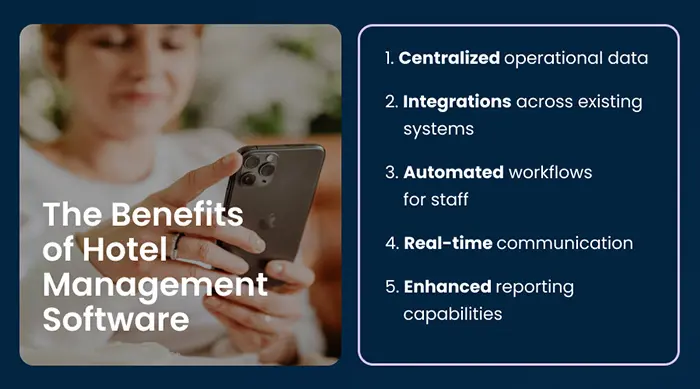
1. Centralizing Guest and Operational Data
At the core of most platforms is guest management software that stores guest profiles, reservation details, payment data and stay history. Booking systems may feed into it. From it, guest data flows out to other systems.
One central source of truth is necessary to maintain consistent, reliable information across applications, departments and workflows. Common centralized data includes:
Guest profiles and reservation details
Payment and billing information
Room status and housekeeping updates
Guest communication history
Service requests and operational notes
2. Integrating with Existing Hotel Systems
The best hotel integrations don’t feel like integrations at all. It’s simply the absence of toggling between tools with complete operational consistency. It simplifies things you do every day, like changing payment information — updating it in one system means having those updates automatically reflected in all linked platforms. Typical integrations to the PMS or other platforms often include:
POS: Matching guest folios with payment information
Booking and distribution channels: Managing live inventory and availability
Guest messaging platforms: Displaying up-to-date service requests and ticket status
3. Automating Guest and Staff Workflows
Automating routine tasks saves time, but the best software will also be a breeze for your guests to use. Technologies like hospitality AI now drive both guest- and team-facing automation of communication in addition to standard hotel workflows. When applied well, managing guest inquiries, triggering automated communications and streamlining service coordination becomes a breeze.
Here are some examples of automated workflows:
Sending pre-arrival instructions or check-in information
Routing guest messages to the correct department
Suggesting responses in guest messaging for team member approval
Notifying staff of service requests in real time
4. Enabling Real-Time Access Across Teams
Stand-up meetings at the beginning of shifts are helpful, but things change quickly. Real-time access across hotel management systems bridges that gap and keeps your hotel operations moving quickly. Reductions in internal phone calls and last-minute fixes is a win all around.
If guests require assistance, having access to the same operational data speeds up response times and minimizes misunderstandings.
5. Enhancing Reporting and Operational Visibility
There is a difference between having data and using data. Hotel management software is here to collect, manage and help you use your hotel’s data for operational decision-making and performance tracking.
Hoteliers who have these insights identify operational bottlenecks and opportunities for improvement. They have an immediate (and clearer) understanding of how the property is performing and where operational adjustments may be needed. Combined with active tracking of guest feedback, it creates an edge — one that HBR reported as one of four cumulative capabilities that drive operational improvement.
What Is the Best Hotel Management Software?
The reality of hotel tech is nuanced. The hotel tech ecosystem is diverse, with different types of hotel management platforms. The best platform depends entirely on your property’s unique DNA: your size, operational complexity and specific guest experience goals.
Instead of chasing a one-size-fits-all solution, the smarter move is to identify which category of software aligns with your primary friction points.
Improve the digital guest journey through mobile check-in, messaging, digital payments and in-stay communication. These tools reduce front desk workload while delivering faster service to guests.
Serve as the operational backbone of many hotels by managing reservations, room inventory, billing and reporting. PMS platforms typically integrate with other hotel technologies to support broader operations.
Optimize pricing, distribution and marketing performance. These systems often include revenue management tools, corporate sales platforms, demand forecasting and channel management capabilities.
All-in-One Hospitality Platforms
Combine several operational management, guest engagement and automation tools through a central vendor platform with the goal of streamlining the hotel tech stack.
While each category serves a purpose, many hotels now prioritize platforms that connect guest engagement and operations across the entire stay. With its AI-powered Guest Engagement Platform, Canary Technologies digitizes the entire guest journey, from booking to checkout, modernizing hotel operations, increasing staff efficiency and revenue opportunities.
What Are the Main Challenges When Implementing Hotel Management Software?
The pitfalls of rolling out new software can be numerous and varied, depending on your hotel and the vendor you select. So what can you do?
Understanding the most common implementation challenges can make planning easier. Here are a few of them:
Driving Staff Adoption and Effective Training
One of the most common challenges is making sure staff actually use the new system. Front desk agents, housekeeping teams and guest services staff must feel confident navigating the platform from day one. This comes down to communicating change, intuitive design and hotel staff training.
Here’s how to ensure high staff adoption rates when you adopt a new hotel management solution:
Provide role-specific training for front desk, housekeeping and management teams, ideally through the vendor
Choose tools with intuitive user interfaces to reduce the learning curve
Assign internal champions who support staff during the transition and stay in direct contact with the vendor’s support team
Offer refresher training as new features or workflows are introduced
Managing Integration Complexity Across Systems
Most properties rely on multiple platforms to design their management suite. Integrating these systems during implementation can be complex if compatibility issues arise. Your chosen vendors should have proactively addressed possibilities and steps needed.
Here’s how to manage integration across your existing hotel systems:
Prioritize integrations with your most critical operational systems first
Confirm API compatibility between platforms before buying
Work with vendors that specialize in hospitality integrations
Test workflows thoroughly before launching the system property-wide
Overcoming Fragmented Guest and Operational Data
Transitioning from disconnected to connected data is like the morning after a sold-out New Year’s Eve party — it’s a massive cleanup. Most hotels start implementation with guest profiles and operational logs across spreadsheets and legacy systems. For duplicates, you must decide which system holds the source of truth. Consolidating this data during implementation is the only way to gain true property-wide visibility.
Here’s how to centralize your data properly:
Migrate historical guest data into the new platform ahead of go-live
Use sandbox environments for trial runs
Work towards specific cutover dates
Establish consistent data standards across departments
Controlling Implementation and Maintenance Costs
Some implementations will be swift and others will cost you time and money. Your vendor should give you a clear idea of what is required beyond the initial purchase. Ask early on about the potential cost of implementation services, integrations, training and ongoing platform maintenance, which can all contribute to the total cost of ownership. By planning for these expenses, you avoid budget surprises later.
Here’s how to maintain control of hotel management software costs:
Request full pricing transparency from vendors before signing contracts
Account for implementation, onboarding and training expenses
Prioritize platforms that reduce manual work and operational inefficiencies
Evaluate long-term value rather than focusing only on upfront pricing
Scaling Software as Hotel Operations Grow
Hotel operations are always evolving. Whether you're expanding services, upgrading your room count or changing a vendor, your operations won't stay static. That means you need a tech stack that works for the hotel you have today and the one you’re building for tomorrow. Scalable hospitality tech solutions allow hotels to add new capabilities without replacing their core technology.
Here’s how to effectively scale your hotel management software solution:
Choose platforms designed for modular expansion
Prioritize vendors that regularly release new features and updates
Ensure the software supports multi-property or brand-level growth
Evaluate whether the platform integrates easily with future technologies
Enhance Guest Experience with Hotel Management Software from Canary
Efficiently managing your hotel’s operations is great, but ultimately, you need to deliver a better guest experience at every stage of the stay. Investing in the right platform allows you to not only streamline service and reduce manual work for staff but also create more personalized interactions for guests.
That’s where Canary’s guest management platform stands out. With Canary's AI-powered Guest Engagement Platform, hotels can streamline operations and provide guests with a more personalized experience from booking through checkout.
With Canary, hotels can:
Digitize arrivals with Mobile Check-In, reducing front desk lines and speeding up the arrivals process
Increase revenue with Dynamic Upsells, turning guest touchpoints into new revenue opportunities
Communicate instantly with Guest Messaging, allowing staff to respond quickly to guest requests
Streamline payments and reduce fraud with Digital Authorizations and Payment Links
Automate guest communication with Canary AI, improving response times while reducing staff workload
Modernize the entire guest journey, from booking confirmations through digital checkout
Book a demo today and see why Canary is trusted by over 20,000 hotels worldwide.
Häufig gestellte Fragen
Was ist die beste Hotelverwaltungssoftware für moderne Hotels?
Die beste Hotelverwaltungssoftware für moderne Hotels hängt von den betrieblichen Anforderungen des Hotels, den Zielen für das Gästeerlebnis und den verfügbaren Personalressourcen ab. Jedes Hotel profitiert von Plattformen, die manuelle Aufgaben reduzieren, die Kommunikation mit Gästen vereinfachen und Routineabläufe automatisieren, sodass kleinere Teams effizienter arbeiten können.
Systeme, die sich problemlos in PMS und andere wichtige Hoteltechnologien integrieren lassen, helfen auch unabhängigen Hotels dabei, einen reibungslosen Betrieb aufrechtzuerhalten, ohne die Komplexität zu erhöhen.
Wie viel kostet Hotelmanagement-Software und wie hoch ist der ROI?
Die Kosten für Hotelverwaltungssoftware variieren stark je nach Art der Plattform, Anzahl der Zimmer, Funktionen und dem Grad der erforderlichen Anpassung. Einige Anbieter berechnen Abonnementpreise, während andere Onboarding, Integrationen oder Schulungen als Teil der Implementierungspakete anbieten können.
Hotels bewerten die Kapitalrendite in der Regel anhand mehrerer betrieblicher Verbesserungen, darunter:
Reduzierter Arbeitsaufwand an der Rezeption und weniger Verwaltungsaufgaben
Höhere Einnahmen aus Upsells und Nebendienstleistungen
Verbesserte Gästezufriedenheit und Bewertungsergebnisse
Weniger Zahlungsstreitigkeiten und betrugsbedingte Verluste
Welche Software eignet sich am besten für die Kommunikation und das Upselling von Hotelgästen?
Plattformen, die sich auf das Engagement von Gästen und digitale Gästeerlebnisse konzentrieren, bieten oft die besten Kommunikations- und Upselling-Funktionen. Hotels, die diese Art von Software verwenden, interagieren mit Gästen über Nachrichten, mobilen Check-in und digitale Serviceanfragen und bieten während des gesamten Aufenthalts personalisierte Upgrade-Möglichkeiten an.
Plattformen für die Interaktion mit Gästen beinhalten in der Regel Tools, die Zimmerupgrades, Optionen für einen späten Check-out, Annehmlichkeiten und andere Zusatzleistungen zu wichtigen Zeitpunkten der Reise des Gastes anbieten. Wenn diese Tools in Betriebssysteme integriert sind, präsentieren sie relevante Angebote, ohne dass dem Hotelpersonal zusätzliche Arbeit entsteht.
Was sind die wichtigsten Merkmale und Funktionen, auf die Sie bei der Hotelverwaltungssoftware achten sollten?
Zu den allgemeinen Fähigkeiten, denen Hotels Priorität einräumen sollten, gehören:
Zentralisierte Reservierungs- und Gastprofilverwaltung
Tools für den mobilen Check-in und den digitalen Checkout
Gastnachrichten- und Kommunikationsplattformen
Zahlungsabwicklung und sichere Autorisierungen
Automatisierung für betriebliche Arbeitsabläufe
Berichterstattung und Leistungsanalyse
Integrationen mit PMS und anderen Hoteltechnologien
Bietet Canary ein zentrales Dashboard, um wichtige Kennzahlen zu überwachen, tägliche Aufgaben einzusehen und Reservierungen zu verwalten?
Ja. Die Plattform von Canary bietet Hotels einen zentralen Überblick über die Interaktionen mit Gästen und die betrieblichen Abläufe. Teams können Reservierungsdetails überwachen, die Kommunikation mit Gästen verfolgen, Aufgaben verwalten und betriebliche Aktivitäten von einer einzigen Oberfläche aus überprüfen.
Wie trägt die Hotelmanagement-Software von Canary zur Umsatzsteigerung bei und welche Funktionen stehen für die Automatisierung des Umsatzmanagements zur Verfügung?
Canary steigert den Hotelumsatz, indem es Kundenkontaktpunkte in Gelegenheiten für Upgrades, Zusatzleistungen und Zusatzleistungen verwandelt. Anstatt sich bei der Präsentation von Angeboten ausschließlich auf die Rezeption zu verlassen, präsentieren Hotels mithilfe der dynamischen Upsells von Canary während der gesamten Reise ihres Gastes digital personalisierte Angebote — vom Angebot von Zimmervergünstigungen beim mobilen Check-In bis hin zur Aufnahme von Zusatzleistungen in einem digitalen Kompendium können Hotels ganz einfach all ihre Optionen präsentieren.
Darüber hinaus bietet Canary eine Reihe von Lösungen an, mit denen die Einnahmen eines Hotels gesichert werden sollen, indem das Risiko von Betrug und Rückbuchungen verringert wird. Digitale Autorisierungen verifizieren beispielsweise Zahlungsinformationen auf sichere Weise, und Payment Links macht es einfach, Einzahlungen oder andere Zahlungen schnell anzunehmen.
Bietet Canary in jeder Phase der Gastreise Upselling- und Nebenumsatzmöglichkeiten?
Ja. Die Plattform von Canary unterstützt Upselling- und zusätzliche Umsatzmöglichkeiten in mehreren Phasen der Gästereise, darunter Zimmer-Upgrades, spätes Auschecken, Parken, Restaurantpakete, Wellnessangebote und andere Zusatzleistungen über automatisierte digitale Touchpoints.
Welche Integrationen sind mit Systemen von Drittanbietern verfügbar?
Hotelverwaltungssoftware lässt sich in der Regel in eine Vielzahl von Hotelsystemen integrieren, darunter Immobilienverwaltungssysteme, Zahlungsabwickler, Gastkommunikationsplattformen und Betriebstools.




.avif)