Revenue management for hotels comes with more gadgets and add-ons than a professional chef’s kitchen. And like a restaurant operation, the best hotel revenue management services are built around your reality. That could mean setting prices to drive Revenue Per Available Room (RevPAR), reducing your dependence on high-commission Online Travel Agencies (OTAs) or uncovering hidden revenue throughout the guest journey.
If you’ve considered revenue management technology but felt paralyzed by the options, you’re in the right place. To help you find clarity, here are the top revenue management services in 2026 and what sets them apart.
Best Hotel Revenue Management Services
Key Features
IDeaS Revenue Solutions
Advanced forecasting, automated pricing decisions, demand-based optimization and enterprise-grade analytics
Duetto
Open pricing model, real-time demand tracking, segmentation insights and strong integrations with Payment Management Systems and Central Reservation Systems
Simple pricing automation, competitor rate tracking, small-to-mid hotel focus and easy onboarding
Cloudbeds (Pricing Intelligence Engine)
Integrated PMS + RMS, automated pricing, demand forecasting and centralized data insights
BEONx (formerly Beonprice)
AI-powered pricing, market intelligence, benchmarking tools and profitability-focused recommendations
Lighthouse (formerly OTA Insight)
Business intelligence, rate shopping, forecasting tools, market demand data and commercial strategy dashboards
Canary Technologies
Drives revenue across the full guest journey with AI-powered upsells and seamless integrations that increase total revenue per guest
What Is a Revenue Management Service for Hotels?
A hotel revenue management service can be two things: a service provided by humans whom you outsource your revenue management to, or a comprehensive technology solution that helps drive your revenue strategy. The tech, not the outsourced service, is what we’re talking about here. Typically, these technologies use several key functionalities to suggest optimal pricing.
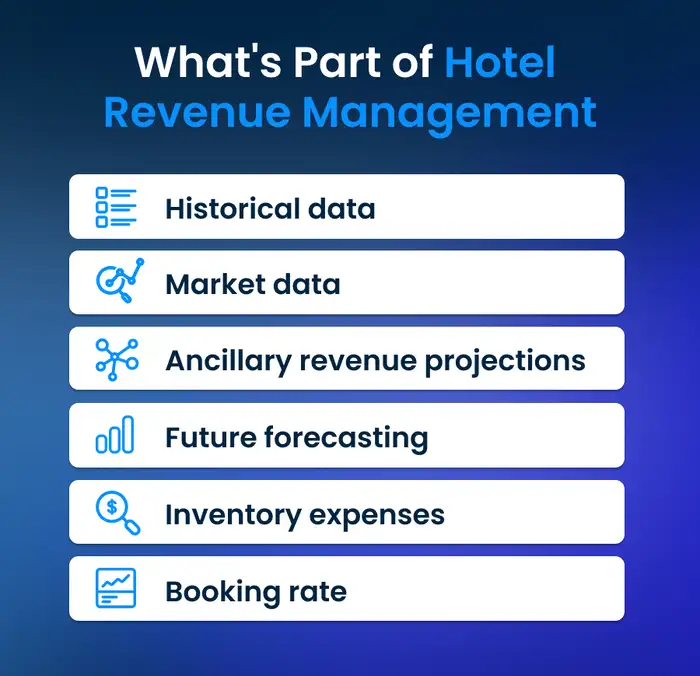
Traditional revenue management systems (RMS) focus heavily on pricing rooms using historical and market data, such as competitor rates. Solutions nowadays power total revenue management by bringing ancillary revenue into the mix through upsell strategies, AI forecasting and PMS integration. This kind of service is only growing in demand: the global hospitality revenue management & pricing analytics market is expected to expand from $4.5 billion USD in 2025 to $13.1 billion USD in 2034, according to Global Market Insights.
9 Best Revenue Management Service Solutions for Hotels in 2026
Anyone looking to find the best hotel revenue management services needs a clear vision of how much day-to-day control they want and which data they want to rely on. The following list contains providers with options to fit various setups. It includes automated systems that take the reins, systems that support onsite revenue managers and RMS to boost total profitability and more. Some may be complete solutions while others layer onto existing systems.
Take a moment to envision your use case and desired impact on your everyday operations, then compare it to each summary.
1. IDeaS Revenue Solutions
IDeaS is a long-standing leader in revenue management systems, best suited for large hotels, resorts and enterprise groups. It also offers scalable versions for smaller properties. Its advanced forecasting is powered by machine learning and deep historical data analysis and can be enhanced with add-ons focused on groups, meetings and events.
Pros of IDeas Revenue Solutions:
Highly advanced forecasting of up to 5 years in advance and automation with explainable AI
Strong enterprise-level reporting and analytics
Cons of IDeas Revenue Solutions:
Intricate setup with substantial historical data required and a steep learning curve
Higher cost compared to other solutions
Limited focus beyond room revenue through add-ons
2. Duetto
Duetto offers a cloud-based RMS ideal for multi-property groups and lifestyle hotels. Its open pricing model allows flexible rate strategies based on real-time demand.
Pros of Duetto:
Flexible open pricing approach, not tied to one “Best Available Rate”
Strong integrations with PMS and CRS systems
Cons of Duetto:
Requires experienced revenue managers to maximize value
Premium pricing tier
Limited built-in guest journey monetization tools
3. Atomize
Atomize is a user-friendly RMS designed for independent hotels and small groups, recently acquired by Mews. It uses AI-driven pricing automation with a simple, intuitive interface.
Pros of Atomize:
Easy to use with fast onboarding, particularly for Mews customers
Automated real-time pricing adjustments
Cons of Atomize:
Limited customization for complex properties
Fewer research-oriented analytics compared to enterprise tools
Optimized for hands-off users
4. FLYR Hospitality
FLYR Hospitality is an AI-first RMS and strategy platform that targets modern, tech-forward hotels looking for real-time pricing intelligence. Its main strength lies in continuous demand tracking and live market data analysis that doesn’t use traditional Comp Sets.
Pros of FLYR Hospitality:
Real-time demand signals and pricing updates
Strong data visualization and insights
Cons of FLYR Hospitality:
Newer platform with an evolving feature set
May require learning to interpret data outputs
Limited guest engagement capabilities
5. RoomPriceGenie
RoomPriceGenie is an RMS built for small to mid-sized independent hotels that want intuitive, automated pricing. It’s easy to use and implement, with dashboard integrations into the PMS.
Pros of RoomPriceGenie:
Simple setup and intuitive interface
Affordable for smaller properties
Cons of RoomPriceGenie:
Basic forecasting compared to advanced RMS platforms
Built for simplicity rather than complex hotel operations
Focuses on room pricing optimization only
6. Cloudbeds Pricing Intelligence Engine
Cloudbeds offers an integrated RMS within its broader PMS platform, ideal for small to mid-sized hotels already using Cloudbeds. Unlike others on this list, it’s an all-in-one system.
Pros of Cloudbeds:
Fully integrated with its own PMS and distribution tools
Centralized data and reporting
Cons of Cloudbeds:
Ecosystem dependency on the use of Cloudbeds PMS
Limited advanced forecasting capabilities
May lack flexibility for complex pricing strategies
7. BEONx
BEONx focuses on AI-driven revenue management for hotels and resorts across multiple revenue streams. It combines pricing optimization with total profitability insights.
Pros of BEONx:
Focuses on profit, not just revenue
Strong benchmarking and market intelligence
Cons of BEONx:
Requires data maturity to get full value
Interface can be complex
Limited guest journey monetization tools
8. Lighthouse
Lighthouse delivers a commercial platform with tools, including pricing optimization, for revenue managers at hotels of all sizes. Its strength lies in competitor rate tracking, market data insights and parity monitoring.
Pros of Lighthouse:
Excellent competitive benchmarking tools
Strong market data insights, including forward-looking data
Cons of Lighthouse:
Module complexity with pricing optimization a recent add-on
Requires pairing with other systems
Limited automation capabilities
9. Canary
Unlike a standalone RMS, Canary’s works in tandem with other systems to drive revenue across the entire guest journey, from discovery through post-stay. By combining AI-powered insights with tools like Dynamic Upsells, Guest Messaging, Mobile Check-In and Smart Checkout, Canary turns every guest interaction into a revenue opportunity.
Checkout surveys boost rankings and, in turn, future revenue; upsell revenue can increase by up to 200%. This approach allows hoteliers to increase total revenue per guest while improving the guest experience.
Pros of Canary:
Drives revenue beyond room pricing with upsells and dedicated guest engagement tools
Uses AI-powered insights to identify high-value opportunities in real time
Seamlessly integrates with PMS and existing hotel tech stack
Key Benefits of Using a Hotel Revenue Management Service
Revenue management is popular because data-backed revenue-generating strategies drive consistent growth. Over several decades, the practice grew to include more data points, moving toward total revenue management — a shift predicted by scholars, including those in this Cornell report, and made possible by advances in technology.
When we look under the hood, modern practice operates on multiple levels. Take a look at more benefits below.
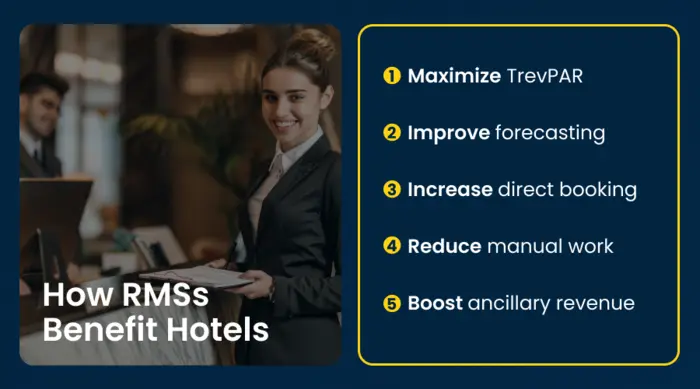
Maximized RevPAR Through Dynamic Pricing
Dynamic pricing ensures your rates always reflect the most strategic way to price a room based on real-time demand, market conditions and competitor positioning. Technology makes it possible to do this easily, rather than making it a manual headache.
This level of responsiveness protects revenue and reduces missed opportunities. Automated pricing keeps your strategy in step with demand shifts without requiring constant manual updates. It automates:
Adjusting pricing based on demand signals
Capturing higher ADR during peak booking windows
Maintaining competitive, consistent rates across all channels
Improved Forecast Accuracy with AI
Hospitality AI has transformed forecasting from formulas and algorithms to “teams of algorithms,” as per Skift. In practice, it has the answer to every “what if” in your morning stand-up meeting.
More accurate forecasts lead to stronger planning across your operation. You align pricing, staffing and inventory decisions with confidence. Accurate forecasting:
Predicts demand fluctuations with greater precision
Identifies booking trends earlier in the cycle
Makes proactive pricing and inventory decisions
Increased Direct Booking Profitability
Revenue management services strengthen your direct booking strategy by aligning pricing, availability and offers across every channel. With the right revenue management service, your conversion rates rise and you depend less on third parties.
Direct bookings crucially protect your margins from OTA fees, which often reach as high as 30% per Skift. You also gain more control over communication and the overall guest experience, so you can build stronger (repeating) relationships. With more direct bookings, you:
Optimize pricing across direct and third-party channels
Increase booking engine conversion rates
Reduce OTA commissions and increase profit margins
Reduced Manual Workload for Revenue Teams
Manual processes slow your team down and keep them from focusing on where they excel. Revenue management services for hotels automate repetitive tasks so your team focuses on strategy and hospitality instead of spreadsheets.
With automation in place, your team works faster and more efficiently. You reduce errors, improve collaboration and free up time for higher-impact work. This serves your property in several ways:
Automates rate updates across all distribution channels
Eliminates time-consuming manual reporting
Centralizes data for faster, better decision-making
Total Revenue Beyond Room Rates Is Unlocked
Total guest spend and TrevPAR come into focus whenever RevPAR becomes a concern.By connecting pricing with upsells and on-property offers, hotels can increase revenue at every touchpoint.
This holistic approach strengthens profitability while enriching the guest experience with choice and autonomy. You can increase your TrevPAR by:
Identifying upsell opportunities throughout the guest journey
Personalizing offers using guest data
Augmenter le revenu total par client, et non pas seulement par chambre
Comment choisir le bon service de gestion des revenus pour votre établissement hôtelier
Le choix du bon service de gestion des revenus dépend de la taille de votre établissement, de l'expertise de votre équipe, de vos objectifs et de votre pile technologique existante. Disposez-vous d'un responsable ou d'une équipe dédiée à la gestion des revenus ? Est-ce votre premier pas vers l'abandon des tarifs statiques ? Si vous explorez les options, ce guide pour le choix d'un RMS peut vous aider à démarrer
Tenez compte des points clés suivants lorsque vous évaluez les options pour les meilleurs services de gestion des revenus hôteliers.
Hotel Revenue Management Service Evaluation Criteria
Why It Matters
Questions to Ask
PMS and Channel Integrations
Seamless integrations ensure real-time data flow between your PMS, CRS and distribution channels. That means new rates updating on all channels, without any wait.
Does it integrate with my PMS and channel manager?
How often does data sync?
Will this reduce manual updates across systems?
Automation Level
Automation reduces manual workload and ensures faster, more accurate pricing decisions. The right level of automation lets your team focus on strategy instead of repetitive tasks.
Strong pricing controls let you adjust strategies based on demand, segments and business goals at any time. Flexibility ensures you stay competitive without losing control.
How customizable are pricing rules?
Can I segment by channel, guest type or season?
Does the system explain pricing decisions?
Scalability
Your revenue management solution should grow with your business. Whether you expand locations or add rooms, the system should handle increased complexity without friction.
Can this support multiple properties?
How does it handle portfolio-level reporting?
Will it scale with future growth?
ROI Timeline
Understanding how quickly you’ll see results helps justify investment and set expectations. The best platforms deliver measurable impact within weeks, not months.
How long until I see revenue lift?
What metrics track success?
Are there case studies or benchmarks available?
Débloquez des opportunités de revenus hôteliers supplémentaires avec Canary
Les hôtels modernes ont besoin de systèmes connectés et intelligents qui génèrent des revenus à chaque point de contact. Canary offre exactement cela en combinant l'engagement des clients, le support opérationnel et l'IA au sein d'une plateforme unique et puissante.
Capturez des revenus tout au long de l' expérience client: Les revenus sont générés tout au long du parcours client, et pas seulement lors de la réservation. La messagerie client IA de Canary envoie des offres personnalisées tout au long du parcours client, des offres avant l'arrivée à l'engagement pendant le séjour et aux suivis après le départ.
Augmenter les revenus additionnels grâce à l'automatisation : Les ventes additionnelles dynamiques de Canary automatisent les offres personnalisées afin que chaque client voie des surclassements pertinents au bon moment. Cela génère des taux de conversion plus élevés, augmente les revenus par réservation et élimine le besoin d'efforts de vente additionnelle manuels.
Complétez votre stratégie de gestion des revenus: Canary améliore votre RMS existant en connectant la tarification aux données clients en temps réel. Cela étend votre stratégie au-delà des tarifs des chambres, vous aidant à augmenter le revenu total par client tout en maintenant une pile technologique intégrée et fluide.
Réservez une démo aujourd'hui pour voir comment Canary aide les hôtels à améliorer leurs services de gestion des revenus existants.